Best trekking poles: shaft materials, locks, grips, and sizing
The best trekking poles match shaft material, locking hardware, and grip ergonomics to your terrain and pack weight. High-strength 7075 or HTS 6.5 aluminum telescoping poles with external lever locks and natural cork grips—like the Black Diamond Pursuit and LEKI Makalu Cork Lite—provide reliable durability for rocky trails and heavy packs, while folding carbon fiber poles cut swing weight and collapsed length for fastpacking and long trail days.
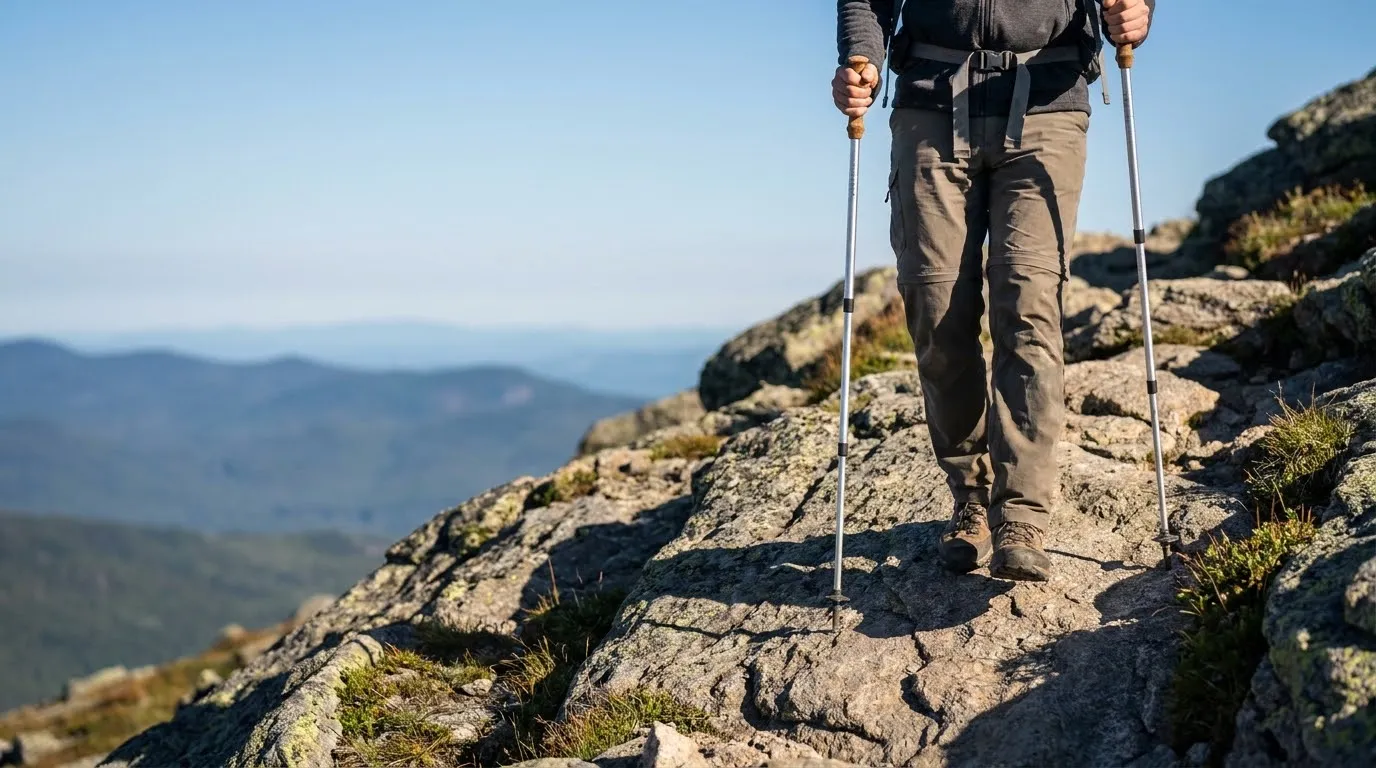
Our picks
We earn a commission if you buy through these links, at no cost to you. Read our affiliate disclosure.
| Award | Product | Shaft material | Design | Weight | Where to buy |
|---|---|---|---|---|---|
| Best overall | Best overallBlack Diamond Pursuit Trekking Poles | 7075 aluminum (30% pre-consumer recycled) | 3-section telescoping with FlickLock+ levers | 17.5 oz (495 g) S/M / 18.9 oz (535 g) M/L | Check price at REI |
| Best ergonomic aluminum poles | Best ergonomic aluminum polesLEKI Makalu Cork Lite Trekking Poles | HTS 6.5 heat-treated aluminum (16/14/12 mm) | 3-section telescoping with Speed Lock Plus levers | 17.6 oz (500 g) standard | Check price at LEKI |
| Best ultralight folding carbon poles | Best ultralight folding carbon polesBlack Diamond Distance Carbon Z Trekking Poles | 100% carbon fiber | 3-section fixed-length folding Z-pole (Speed Cone) | — | Check price at REI |
| Best ultralight adjustable carbon poles | Best ultralight adjustable carbon polesGossamer Gear LT5 Three-Piece Carbon Trekking Poles | Carbon fiber | 3-section telescoping with twist locks | 9.8 oz (278 g) | Check price at Gossamer Gear |
| Best value aluminum poles | Best value aluminum polesBlack Diamond Trail Trekking Poles | 7075 aluminum | 3-section telescoping with dual FlickLock levers | — | Check price at REI |
| Best compact all-around aluminum poles | Best compact all-around aluminum polesLEKI Khumbu Lite Trekking Poles | HTS 6.5 heat-treated aluminum (16/14/12 mm) | 3-section telescoping with Speed Lock Plus levers | 17.6 oz (498 g) | Check price at LEKI |
- Best overall
Black Diamond Pursuit Trekking Poles
Ergonomic cork grips, algae-infused foam extensions, and FlickLock+ aluminum shafts come in two grip-and-shaft size combinations for a tailored fit.
- Shaft material
- 7075 aluminum (30% pre-consumer recycled)
- Design
- 3-section telescoping with FlickLock+ levers
- Grip
- Natural cork with Bloom foam extension
- Weight pair
- 17.5 oz (495 g) S/M / 18.9 oz (535 g) M/L
- Usable length
- 100-125 cm (S/M) / 125-140 cm (M/L)
- Best ergonomic aluminum poles
LEKI Makalu Cork Lite Trekking Poles
Hollow-core Aergon Air Cork grips with a rubberized top palming surface and Speed Lock Plus levers give steep-terrain hikers secure wrist-to-palm support.
- Shaft material
- HTS 6.5 heat-treated aluminum (16/14/12 mm)
- Design
- 3-section telescoping with Speed Lock Plus levers
- Grip
- Aergon Air Cork with foam extension
- Weight pair
- 17.6 oz (500 g) standard
- Usable length
- 100-135 cm (standard) / 90-125 cm (compact)
- Packed length
- 67 cm (26.4 in)
- Warranty
- 2-year shaft defect warranty (bent/broken shafts excluded); limited lifetime locking mechanism warranty
- Best ultralight folding carbon poles
Black Diamond Distance Carbon Z Trekking Poles
Three-section Z-pole folding carbon shafts deploy in seconds for fastpacking, trail running, and peak bagging.
- Shaft material
- 100% carbon fiber
- Design
- 3-section fixed-length folding Z-pole (Speed Cone)
- Grip
- Ultralight EVA foam with grip extension
- Best ultralight adjustable carbon poles
Gossamer Gear LT5 Three-Piece Carbon Trekking Poles
At 9.8 ounces per pair with a 60-to-130-centimeter twist-lock adjustment range and a marked 125-centimeter tent setting, these poles double as ultralight shelter struts.
- Shaft material
- Carbon fiber
- Design
- 3-section telescoping with twist locks
- Grip
- Custom EVA foam
- Weight pair
- 9.8 oz (278 g)
- Usable length
- 60-130 cm (23.5-51 in)
- Packed length
- 60 cm (23.5 in)
- Warranty
- 1-year manufacturing defect warranty (pole breakage and Lightrek carbon fiber tubing excluded)
- Best value aluminum poles
Black Diamond Trail Trekking Poles
Dual FlickLock clamps, 7075 aluminum shafts, and EVA foam grips with lower choke-up extensions deliver dependable four-season adjustability at an entry-level cost.
- Shaft material
- 7075 aluminum
- Design
- 3-section telescoping with dual FlickLock levers
- Grip
- EVA foam with grip extension
- Usable length
- 100-140 cm (39-55 in)
- Best compact all-around aluminum poles
LEKI Khumbu Lite Trekking Poles
Slender 16/14/12-millimeter HTS 6.5 aluminum tubing and Aergon CorTec cork-blend grips give smaller-framed hikers a nimble, vibration-damping telescoping pole.
- Shaft material
- HTS 6.5 heat-treated aluminum (16/14/12 mm)
- Design
- 3-section telescoping with Speed Lock Plus levers
- Grip
- Aergon CorTec cork composite
- Weight pair
- 17.6 oz (498 g)
- Usable length
- 100-135 cm
- Packed length
- 67 cm (26.4 in)
- Warranty
- 2-year shaft defect warranty (bent/broken shafts excluded); limited lifetime locking mechanism warranty
On this page
Why hikers carry trekking poles
Trekking poles do far more than steady your balance on a slick log crossing. By engaging your shoulders, arms, and core on every stride, a pair of poles turns two-legged walking into four-point propulsion on climbs and absorbs cumulative impact on descents. As highlighted in our core hiking gear guide, poles also serve as structural support struts for many modern non-freestanding backpacking shelters, eliminating the weight of dedicated tent poles.
On steep downhill grades, your knees and quadriceps absorb repeated braking forces multiplied by the weight of your backpack. Planting trekking poles slightly ahead of your boots transfers a portion of each step’s load into your upper body, reducing joint soreness and keeping your ankles stable across loose scree, wet tree roots, and boulder-strewn creek beds. Poles also keep your hands elevated near heart level as you walk, preventing the uncomfortable finger swelling that many hikers experience during long warm-weather miles.
Choosing the right pair comes down to five mechanical variables: shaft material (aluminum versus carbon fiber), collapsing geometry (telescoping versus folding), locking hardware, grip material, and proper sizing.
Change Gear earns a commission when you buy through some links on this page, at no cost to you. It never decides what we recommend.
The picks: best trekking poles for hiking and backpacking
Best overall: Black Diamond Pursuit Trekking Poles
The Black Diamond Pursuit Trekking Poles earn our top spot for general hiking and backpacking because they address hand and wrist ergonomics alongside rugged shaft strength. Constructed from 7075 aluminum containing 30 percent pre-consumer recycled content, the three-section telescoping shafts secure with soft-touch FlickLock+ external lever clamps and include a 1.5-millimeter hex bit tucked directly into the shaft for trailside tension adjustments.
Unlike one-size-fits-all poles, Black Diamond offers the Pursuit in two distinct size-and-grip pairings: a Small/Medium version (usable length 100 to 125 centimeters, weighing 495 grams or 17.5 ounces per pair) with a smaller-diameter grip for small-to-medium hands, and a Medium/Large version (125 to 140 centimeters, weighing 535 grams or 18.9 ounces per pair) with a fuller grip circumference. Both feature natural cork handles shaped to keep wrists neutral, paired with algae-infused Bloom foam lower grip extensions for choking up on steep switchbacks.
Best ergonomic aluminum poles: LEKI Makalu Cork Lite Trekking Poles
For hikers who frequently palm the tops of their poles on long descents, the LEKI Makalu Cork Lite stands out for its Aergon Air Cork grip geometry. LEKI molds a hollow-core handle wrapped in natural cork on the main grip zone and tops it with a wide, edgeless, rubberized palming platform to support the hand when palming the top of the pole.
The “Lite” designation indicates narrower 16-, 14-, and 12-millimeter HTS 6.5 heat-treated aluminum shaft tubing (compared to 18/16/14 millimeters on standard heavy-duty Makalu models), keeping pair weight to roughly 500 grams (17.6 ounces) while adjusting from 100 to 135 centimeters via external Speed Lock Plus levers. A shorter Compact variant spans 90 to 125 centimeters at roughly 476 grams per pair, making the Makalu Cork Lite easy to match to any stride.
Best ultralight folding carbon poles: Black Diamond Distance Carbon Z Trekking Poles
When low swing weight and tiny packed size take priority over length adjustability, the Black Diamond Distance Carbon Z is the reference standard for fastpackers, trail runners, and peak baggers. Built from 100 percent carbon fiber in a three-section folding Z-pole configuration, a pair is among the lightest options here. Black Diamond sells it in fixed lengths, so check its product page for the current length options and weights.
To deploy them, you pull the grip away from the upper shaft until the internal tension cord guides the tapered Speed Cone joints together and a single metal push-button clicks into place. When folded, the poles collapse small, sliding easily inside a daypack or clipping onto a running vest. Because they are fixed-length poles with ultralight carbon walls, they are best suited for fast movement on maintained trails rather than off-trail boulder scrambling or pitching variable-height shelters.
Best ultralight adjustable carbon poles: Gossamer Gear LT5 Three-Piece Carbon Trekking Poles
Backpackers who carry trekking-pole shelters—such as those covered in our guide to the best ultralight tents—need poles that adjust precisely to their shelter’s required pitch height while staying as light as possible. The Gossamer Gear LT5 Three-Piece Carbon Trekking Poles weigh just 139 grams (4.9 ounces) per pole, or 278 grams (9.8 ounces) per pair, making them lighter than many fixed-length folding poles while offering a full 60-to-130-centimeter (23.5-to-51-inch) telescoping range.
The LT5 achieves this low weight by pairing thin-walled carbon fiber tubing with sculpted custom EVA foam grips and low-profile internal twist-lock expanders. Gossamer Gear prints a dedicated 125-centimeter tent-pitch indicator mark directly on the shaft for rapid camp setup. As the manufacturer explicitly notes in its warranty documentation, sub-5-ounce carbon poles prioritize featherweight efficiency over heavy-duty lateral impact strength, so hikers must avoid wedging the tips deep into rock crevices.
Best value aluminum poles: Black Diamond Trail Trekking Poles
Hikers who want dependable three-season adjustability without paying a premium for cork handles or carbon fiber will find everything they need in the Black Diamond Trail Trekking Poles. Spanning a broad 100-to-140-centimeter usable range, these three-section 7075 aluminum poles use Black Diamond’s FlickLock lever clamps.
Soft EVA foam grips with integrated lower foam extensions keep hands comfortable in both warm and cool weather, while wide, plush wrist straps distribute downward pressure across the heel of the hand. Both trekking baskets and snow baskets are compatible with the interchangeable carbide flex tips, making the Trail a versatile workhorse for year-round day hike checklists and weekend backpacking trips.
Best compact all-around aluminum poles: LEKI Khumbu Lite Trekking Poles
The LEKI Khumbu Lite offers the same 16/14/12-millimeter HTS 6.5 heat-treated aluminum shaft architecture and external Speed Lock Plus lever clamps as the Makalu Cork Lite, but pairs them with LEKI’s classic Aergon CorTec grip—which LEKI says contains 80 percent natural cork combined with soft material for durability.
At roughly 498 grams (17.6 ounces) per pair with a 100-to-135-centimeter adjustment range and a 67-centimeter collapsed length, the CorTec grip resists chipping and edge wear when tossed into car trunks or strapped to the outside of a pack. It is an ideal match for hikers who want German-engineered lever locks and cork-composite comfort in a trim, mid-priced aluminum package.
Aluminum vs carbon fiber shafts
The choice between aluminum and carbon fiber affects four things on the trail: swing weight, vibration damping, failure mode under stress, and price.
Aluminum shafts (7075 and HTS 6.5)
Quality aluminum trekking poles use high-tensile aerospace alloys—most commonly 7075-T6 aluminum or LEKI’s proprietary HTS (Highest Treated Shaft) 6.5 aluminum.
- Strength and failure mode: Aluminum has high ductility. If you trip while descending a talus slope and your full body weight falls sideways onto a pole wedged between two boulders, an aluminum shaft will usually bend rather than break cleanly. In many cases, a slightly bent aluminum lower section can still support weight to get you back to the trailhead.
- Weight and feel: Aluminum pairs typically weigh between 16 and 20 ounces (450 to 570 grams). When carbide tips strike hard granite or pavement, aluminum transmits a noticeable metallic ping and higher vibration up to your hands.
- Best use case: Rocky trails, off-trail bushwhacking, winter snowshoeing, heavy multi-day packs, and budget-conscious buyers.
Carbon fiber shafts
Carbon fiber shafts are formed by layering carbon filaments in an epoxy resin matrix, creating tubing with a high stiffness-to-weight ratio.
- Weight and vibration damping: Carbon poles typically weigh between 9 and 15 ounces (255 to 425 grams) per pair. Because lighter shafts reduce rotational inertia at the end of your arm, lifting and planting a carbon pole 20,000 times over a 10-mile hike feels noticeably less tiring. Carbon composite also absorbs high-frequency shock when the tip strikes rock.
- Strength and failure mode: Carbon fiber is exceptionally strong under vertical compression (pressing straight down on the grip), but vulnerable to sharp lateral impacts and surface nicks. If a sharp quartz ledge scores the outer wall of a carbon tube or your knee falls sideways against a trapped pole tip, the shaft can fracture or splinter abruptly without warning.
- Best use case: On-trail backpacking, thru-hiking, trail running, fastpacking, and hikers with sensitive wrists or elbows who benefit from reduced swing weight and vibration.
Folding vs telescoping designs and locking mechanisms
How a trekking pole collapses determines both its packed length and how versatile it is on variable grades and in camp.
Telescoping poles
Telescoping poles consist of two or three concentric tubes that slide inside one another, collapsing to roughly 24 to 27 inches (60 to 68 centimeters). Because each joint locks independently anywhere along its measurement scale, telescoping poles let you fine-tune length by the centimeter for uphill climbs, steep descents, side-hilling across a traverse, or pitching a shelter at exact heights between 110 and 135 centimeters. Their main drawback is packed length: even fully collapsed, they stick out above the top of most small daypacks and must be strapped externally.
Folding (Z-style) poles
Folding poles divide the shaft into three or four linked segments threaded over a Kevlar or polyethylene tension cord, similar to an avalanche probe or tent pole. When unlocked, the segments fold alongside one another in a “Z” pattern, shrinking down to 13 to 17 inches (33 to 44 centimeters).
- Fixed-length folding poles: Models like the Black Diamond Distance Carbon Z eliminate adjustment clamps entirely to save weight. You must order the exact centimeter length that matches your height, and you cannot lengthen them for descents or use them for tents that require a specific non-matching pitch height.
- Hybrid adjustable folding poles: Some folding models add a single mini lever clamp above the top folding joint, giving you 15 to 20 centimeters of height adjustment while preserving a compact folded footprint.
Lever locks vs twist locks vs push-button locks
- External lever locks (FlickLock, Speed Lock): A cammed lever on the outside of the shaft clamps around the lower tube. Lever locks are the industry favorite because you can see at a glance whether they are closed, adjust them in seconds while wearing cold-weather gloves or a hiking rain jacket, and tighten the tension screw in the field if a section ever slips.
- Internal twist locks: Rotating one shaft section clockwise relative to the next expands an internal friction plug against the inner wall of the tube. Twist locks create a clean, snag-free profile and shave grams on ultralight poles like the Gossamer Gear LT5, but they require care: over-tightening or getting grit and ice inside the expander can cause the mechanism to spin freely until disassembled and cleaned.
- Push-button / cord tension locks: Used on folding Z-poles, a spring-loaded metal pin snaps into a hole once the internal cord is pulled taut. They deploy faster than any other system but offer no length adjustment on their own.
Grip materials, wrist straps, and trail tips
Your hands hold trekking pole grips for hours at a time, making handle material and strap technique critical for preventing palm blisters.
Cork vs EVA foam vs rubber grips
- Natural cork and cork composites: Cork resists moisture from sweaty palms, dampens trail vibrations transmitted up the shaft, and slowly conforms to the shape of your hand. It is the top choice for warm and temperate three-season hiking.
- EVA (ethylene-vinyl acetate) foam: Closed-cell EVA foam is the lightest grip material, feels soft immediately without a break-in period, and does not absorb water during heavy rain. Many poles include a thin sleeve of EVA foam extending 4 to 6 inches down the upper shaft below a cork main grip so you can choke down on steep uphill steps without stopping to shorten the locks.
- Rubber: Dense rubber insulates hands from conductive cold and blocks melting snow, making it purpose-built for winter mountaineering and ski touring where hikers wear insulated gloves. With bare sweaty hands in summer, rubber feels slick and causes friction blisters.
How to use wrist straps properly
Many beginners thread their hand straight through the wrist strap from the front and squeeze the handle tightly—a mistake that fatigues forearm muscles and risks a sprained thumb if you fall. Instead, bring your hand up from underneath the strap loop, then pull your hand down so the strap cradles the heel of your palm and wraps around the back of your wrist as your fingers lightly close around the grip. With this technique, your skeletal frame rests on the tensioned strap on every pole plant, allowing a relaxed grip that saves hand energy all day.
Tips and baskets
Most technical poles come with recessed carbide steel tips that bite into granite, packed dirt, and ice. Manufacturers also include removable slip-on rubber tip protectors (boots) for rocky scrambling areas, boardwalks, and sensitive alpine trails where Leave No Trace principles discourage scarring rock surfaces. Small threaded trekking baskets prevent the tips from plunging too deeply into mud or cracks, and can be swapped for wider snowflake baskets in winter snow.
Sizing your trekking poles and adjusting for terrain
To find your flat-ground baseline length, stand tall in your trail footwear with your arms hanging naturally at your sides, then bend your elbow to a 90-degree angle so your forearm is parallel to the ground. Measure the distance in centimeters from the ground up to the center of your closed fist:
- Hiker height under 5’3” (160 cm): 100 to 105 cm pole length
- Hiker height 5’4” to 5’7” (163 to 170 cm): 110 to 115 cm pole length
- Hiker height 5’8” to 5’11” (173 to 180 cm): 115 to 120 cm pole length
- Hiker height 6’0” to 6’3” (183 to 191 cm): 125 to 130 cm pole length
- Hiker height over 6’3” (191+ cm): 130 to 140 cm pole length
If you are choosing a fixed-length folding pole and fall right on the border between two sizes, sizing down by 5 centimeters is generally easier on the shoulders during climbs than using a pole that is too tall. On three-section adjustable poles with two lever locks, set both the middle and lower sections to the same centimeter number so shaft overlap and bending strength stay evenly distributed across both joints. You can track your pole weight alongside the rest of your kit in our backpacking checklist or custom packing list tool.
How we chose
We don’t test gear ourselves. We choose picks through a detailed comparison of published manufacturer specifications, shaft alloy and carbon layup ratings, locking hardware designs, warranty terms, and the consistent pattern of verified-owner reviews at major outdoor retailers.
We focus on models with replaceable carbide tips, serviceable locking mechanisms, and documented durability across both day-hiking and multi-day backpacking conditions. For a full explanation of how we research and select outdoor equipment, read our gear selection methodology.
Frequently asked questions
Are aluminum or carbon fiber trekking poles better for hiking?
Aluminum trekking poles are better for rugged off-trail hiking, talus fields, heavy backpacking loads, and budget-conscious hikers because aircraft-grade aluminum bends rather than snapping abruptly under lateral stress. Carbon fiber trekking poles are lighter, stiffer, and better at dampening high-frequency trail vibrations, reducing arm and wrist fatigue over high-mileage days. However, if a carbon shaft is deeply scratched against sharp granite or wedged between rocks during a stumble, it can splinter or snap suddenly.
What is the difference between folding and telescoping trekking poles?
Telescoping trekking poles use two or three concentric shaft sections that slide inside one another and secure with external lever clamps or twist locks, offering a wide height adjustment range for steep slopes and pitching trekking-pole shelters. Folding (Z-style) poles work like tent poles: an internal tension cord pulls three or four short segments together and locks with a push button or single top clamp, collapsing to roughly 13 to 17 inches so they fit completely inside a daypack.
How do you size trekking poles to your height?
Stand upright in your hiking shoes on a flat surface and hold the pole grip with the tip resting on the ground near your boot. Adjust the shaft length until your forearm is parallel to the floor and your elbow forms a 90-degree angle. As a general height baseline, hikers under 5 feet 3 inches typically set poles around 100 to 105 centimeters, hikers between 5 feet 4 inches and 5 feet 11 inches use 110 to 120 centimeters, and hikers 6 feet or taller use 125 to 135 centimeters.
Should you shorten or lengthen trekking poles for uphill and downhill hiking?
Shorten adjustable trekking poles by roughly 5 to 10 centimeters (2 to 4 inches) on sustained uphill climbs so you can plant the tips ahead of you without raising your shoulders or over-bending your elbows. On steep, sustained descents, lengthen the poles by 5 to 10 centimeters beyond your flat-ground setting so the tips contact the lower trail surface early while keeping your torso upright and offloading eccentric braking forces from your knees and quadriceps.
Are cork grips better than foam or rubber grips on trekking poles?
Cork grips are preferred by three-season hikers with sweaty hands because natural cork resists moisture absorption, dampens shaft vibration, and gradually molds to the contours of your palm over dozens of miles. EVA foam grips are lighter, softer to the touch immediately out of the box, and absorb sweat without becoming slippery, making them popular on ultralight and trail-running poles. Rubber grips insulate hands against cold conduction and block moisture in freezing winter conditions, though they can chafe bare skin in hot summer weather.
Can you bring trekking poles in carry-on luggage on an airplane?
Under Transportation Security Administration (TSA) rules in the United States, trekking poles with sharp metal or carbide tips are prohibited in carry-on bags and must be packed inside checked luggage. Even compact folding Z-poles that fit inside a backpack are frequently flagged at airport security checkpoints because of their pointed tips and rigid club-like shafts. If traveling by air to a trailhead, pack your poles in a checked duffel or ship them ahead in a rigid cardboard mailing tube.
Sources
- REI Expert Advice: Trekking Poles and Hiking Staffs — How to Choose
- Black Diamond Equipment: Pursuit Trekking Poles Technical Specifications
- Black Diamond Equipment: Distance Carbon Z Poles Technical Specifications
- LEKI USA: Makalu Cork Lite Trekking Poles Technical Specifications
- Gossamer Gear: LT5 Three-Piece Carbon Trekking Poles Specifications