Best backpacking water filter: squeeze, gravity, and purifiers
The best backpacking water filter uses a 0.1-micron or 0.2-micron hollow-fiber membrane to physically strain bacteria and protozoan cysts from backcountry streams while weighing under four ounces. For solo hikers on North American trails, squeeze filters like the Sawyer Squeeze and Platypus QuickDraw balance flow rate, field cleanability, and durability. Hikers traveling where human sewage introduces waterborne viruses require an electroadsorptive, chemical, or mechanical purifier instead.
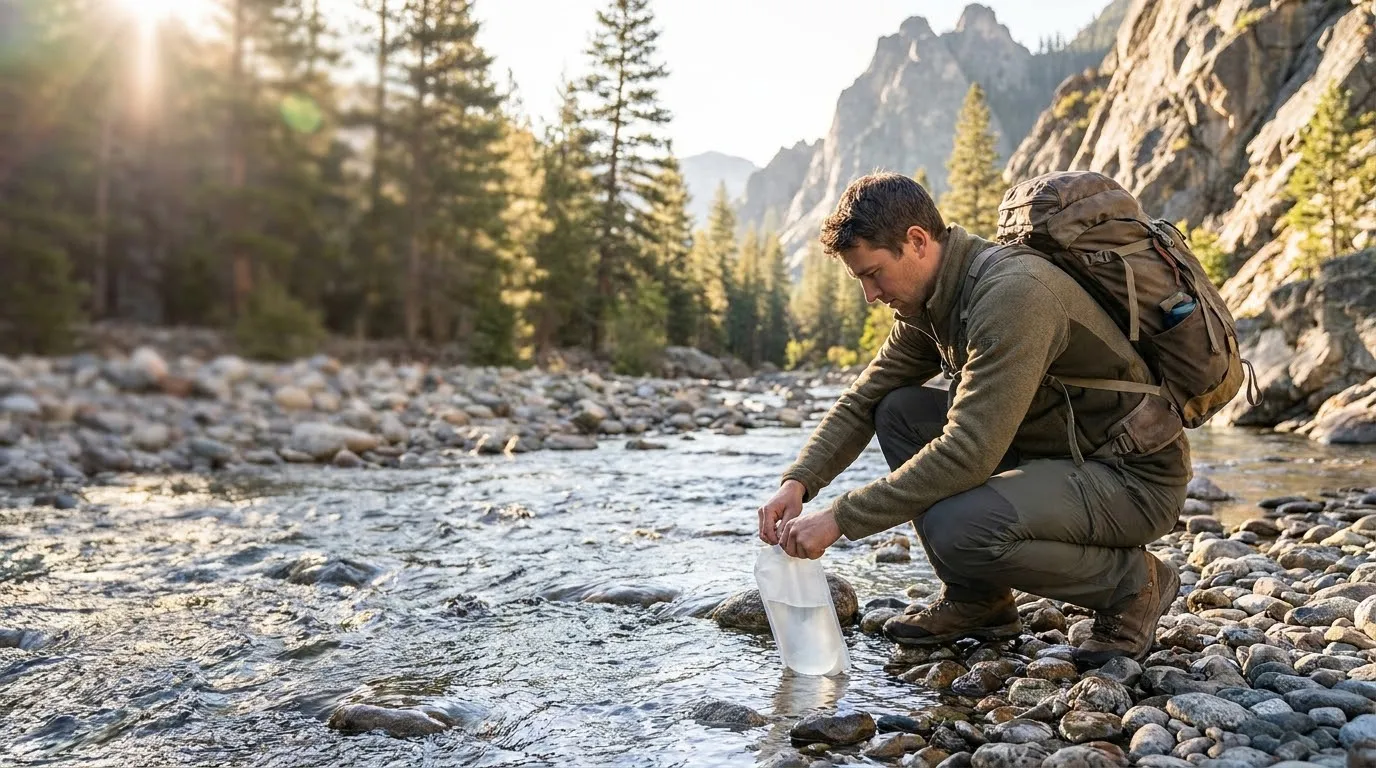
Our picks
We earn a commission if you buy through these links, at no cost to you. Read our affiliate disclosure.
| Award | Product | Type | Pore size | Weight | Where to buy |
|---|---|---|---|---|---|
| Best overall | Best overallSawyer Squeeze Water Filter System | Hollow-fiber squeeze filter | 0.1 micron absolute | 3.0 oz (85 g) | Check price at REI |
| Best fast-flow squeeze filter | Best fast-flow squeeze filterPlatypus QuickDraw Microfilter System | Hollow-fiber squeeze filter | 0.2 micron | 2.4 oz (69 g) minimum / 2.9 oz (83 g) total | Check price at REI |
| Best ultralight soft-flask filter | Best ultralight soft-flask filterKatadyn BeFree 1.0L Water Filter | Hollow-fiber soft-flask squeeze filter | 0.1 micron | 2.2 oz (63 g) | Check price at Katadyn |
| Best gravity filter for groups | Best gravity filter for groupsPlatypus GravityWorks 4.0L Water Filter System | Hollow-fiber gravity filter | 0.2 micron | 11.5 oz (326 g) | Check price at REI |
| Best press purifier for viruses | Best press purifier for virusesGRAYL GeoPress 24 oz Water Purifier Bottle | Electroadsorptive press purifier | 5.0 L/min (8 seconds per 24 oz) | 15.9 oz (450 g) | Check price at REI |
| Best heavy-duty pump purifier | Best heavy-duty pump purifierMSR Guardian Purifier | Hollow-fiber pump purifier | 0.02 micron | 17.3 oz (490 g) | Check price at REI |
- Best overall
Sawyer Squeeze Water Filter System
A 0.1-micron absolute hollow-fiber membrane, standard 28 mm bottle threading, and a lifetime limited warranty make it a lightweight, widely used backcountry microfilter.
- Type
- Hollow-fiber squeeze filter
- Pore size
- 0.1 micron absolute
- Weight
- 3.0 oz (85 g)
- Warranty
- Lifetime limited
- Best fast-flow squeeze filter
Platypus QuickDraw Microfilter System
Dual inside-outside threading, a 3.0-liter-per-minute squeeze flow rate, and a field-testable integrity check solve the usability headaches of older squeeze filters.
- Type
- Hollow-fiber squeeze filter
- Pore size
- 0.2 micron
- Weight
- 2.4 oz (69 g) minimum / 2.9 oz (83 g) total
- Flow rate
- 3.0 L/min
- Lifespan
- 1,000 liters
- Standard
- NSF Protocol P231
- Best ultralight soft-flask filter
Katadyn BeFree 1.0L Water Filter
A wide 42 mm collapsible flask and an easy-swish 0.1-micron membrane deliver fast on-the-move hydration without carrying a backflushing syringe.
- Type
- Hollow-fiber soft-flask squeeze filter
- Pore size
- 0.1 micron
- Weight
- 2.2 oz (63 g)
- Flow rate
- Up to 2.0 L/min
- Lifespan
- 1,000 liters
- Best gravity filter for groups
Platypus GravityWorks 4.0L Water Filter System
Hands-free dual-reservoir suspension processes four liters of camp water in under three minutes without manual squeezing or pumping.
- Type
- Hollow-fiber gravity filter
- Pore size
- 0.2 micron
- Weight
- 11.5 oz (326 g)
- Flow rate
- 1.75 L/min
- Lifespan
- 1,500 liters
- Standard
- EPA & NSF guidelines (per Platypus)
- Best press purifier for viruses
GRAYL GeoPress 24 oz Water Purifier Bottle
Electroadsorptive media and ultra-powdered activated carbon remove viruses, bacteria, protozoa, heavy metals, and chemicals in a single eight-second press.
- Type
- Electroadsorptive press purifier
- Weight
- 15.9 oz (450 g)
- Flow rate
- 5.0 L/min (8 seconds per 24 oz)
- Lifespan
- 65 gallons (250 L / 350 cycles)
- Standard
- NSF/ANSI 42 and 53
- Best heavy-duty pump purifier
MSR Guardian Purifier
Engineered to military NSF Protocol P248 standards, its 0.02-micron hollow-fiber cartridge removes viruses and self-cleans on every pump stroke in silty water.
- Type
- Hollow-fiber pump purifier
- Pore size
- 0.02 micron
- Weight
- 17.3 oz (490 g)
- Flow rate
- 2.5 L/min
- Lifespan
- 10,000+ liters
- Standard
- NSF Protocol P248
On this page
Why backcountry water treatment matters on every hike
Even high-elevation alpine streams fed by snowmelt carry invisible microbiological hazards from wildlife and upstream human visitors. Selecting a reliable hydration treatment system is a foundational pillar of our hiking gear guide because carrying all the water required for a full day or multi-day route is rarely practical. Water weighs approximately 2.2 pounds per liter, meaning a hiker who refills and treats stream water along the route saves four to eight pounds of pack weight compared to hauling a full day’s supply from the trailhead.
Choosing the right device requires matching your filtration method to the biological threats in your watershed, the turbidity of your water sources, and the number of people in your group. A lightweight squeeze microfilter excels for solo hikers pulling from clear mountain creeks, while basecamp groups and international travelers face very different operational demands.
Change Gear earns a commission when you buy through some links on this page, at no cost to you. It never decides what we recommend.
Water filter versus water purifier: bacteria, protozoa, and viruses
The most important technical distinction in backcountry hydration is the difference between a microfilter and a purifier. According to guidance from the Centers for Disease Control and Prevention (CDC), untreated surface water contains three main classes of disease-causing microorganisms, each varying dramatically in physical size and resistance to treatment.
Protozoan parasites (1 to 15 microns)
Protozoa such as Giardia intestinalis and Cryptosporidium are the largest biological pathogens in backcountry water, typically measuring between 1 and 15 microns across. When shed into water via animal or human feces, these single-celled parasites form tough outer protective shells called cysts or oocysts.
Because Cryptosporidium oocysts resist standard chemical disinfectants like iodine and household chlorine bleach, the CDC recommends physical filtration using a microfilter with an absolute pore size of 0.3 microns or smaller (or certification for cyst and oocyst reduction) to reliably trap them.
Bacteria (0.2 to 10 microns)
Waterborne bacteria, including Escherichia coli (E. coli), Salmonella, Campylobacter, and Shigella, are smaller than protozoan cysts, with single cells measuring roughly 0.2 to 10 microns in length. Standard hollow-fiber microfilters rated at 0.1 or 0.2 microns physically block bacteria from passing into your clean drinking vessel. Bacteria are also rapidly neutralized by chemical disinfectants, ultraviolet (UV) light, and boiling.
Viruses (0.01 to 0.1 microns)
Waterborne viruses such as Norovirus, Rotavirus, and Hepatitis A are orders of magnitude smaller than bacteria, measuring roughly 0.01 to 0.1 microns (10 to 100 nanometers). Because their diameter is smaller than the 0.1-micron or 0.2-micron pores of standard backpacking microfilters, viruses pass straight through standard squeeze, gravity, and pump filters.
As the CDC backcountry water treatment guide emphasizes, neutralizing viruses requires one of four approaches:
- Boiling: Bringing water to a rolling boil for one full minute (or three minutes at elevations above 6,500 feet) kills all protozoa, bacteria, and viruses.
- Mechanical or electroadsorptive purifiers: Advanced purifiers use either ultra-tight 0.02-micron pores (such as the MSR Guardian) or positively charged electroadsorptive media (such as the GRAYL GeoPress) to trap viral particles physically and electrochemically.
- Ultraviolet (UV-C) light: Handheld UV purifiers scramble the DNA and RNA of viruses, bacteria, and protozoa in clear water so they cannot reproduce.
- Combined filtration and chemical disinfection: For cloudy water where viruses are a concern, the CDC recommends filtering the water first to remove sediment and Cryptosporidium cysts, then adding a chemical disinfectant like chlorine dioxide to inactivate viruses.
Comparing treatment designs: squeeze, gravity, pump, UV, and tablets
Backcountry water treatment systems fall into five main mechanical and chemical categories. Understanding how each operates helps you organize both a multi-day backpacking checklist and an ultralight day hike checklist.
Squeeze microfilters
Squeeze filters dominate modern trail use because they contain no moving parts and weigh between 2 and 3.5 ounces. Inside the plastic housing sits a dense bundle of microscopic U-shaped or linear hollow fibers perforated with 0.1-micron or 0.2-micron pores. You scoop water into a flexible pouch or narrow-mouth plastic bottle, thread the filter onto the top, and squeeze the vessel to force water through the side walls of the hollow fibers.
- Strengths: Featherlight weight, compact packed size, immediate drinking water with zero wait time, and low cost. Models like the Sawyer Squeeze and Platypus QuickDraw thread directly onto standard 28 mm disposable water bottles.
- Limitations: Scooping water into narrow pouches in shallow trickles can be frustrating without a wide-mouth collection bladder. Hand fatigue builds when squeezing more than two or three liters at once, and freezing temperatures ruin the wet membrane.
Gravity filters
Gravity systems use the same 0.1-micron or 0.2-micron hollow-fiber cartridges found in squeeze filters, but pair them with high-capacity reservoirs (typically 3 to 6 liters) and silicone transfer tubing. You fill the dirty reservoir at a lake or stream, hang it from a tree branch, and let gravity pull the water down through the inline filter into a clean vessel or hydration bladder.
- Strengths: Completely hands-free operation in camp. While four liters of water filter automatically over two to three minutes, you can pitch your shelter from our ultralight tents guide or prepare dinner.
- Limitations: Heavier (typically 8 to 12 ounces for complete dual-bag setups) and slower than manual squeezing if the vertical drop between bags is short or the cartridge accumulates silt.
Pump filters and purifiers
Pump systems draw water through a submerged intake hose fitted with a coarse pre-filter screen, using a manual piston handle to push water through a ceramic, fiberglass, or hollow-fiber cartridge.
- Strengths: The intake hose allows you to draw water from shallow rock seeps and puddles only an inch deep without disturbing bottom mud. High-end pump purifiers like the MSR Guardian flush sediment back out to the waste port on every stroke.
- Limitations: Heavy (often 10 to 18 ounces), bulky inside a pack, and mechanically complex with O-rings and valves that require periodic field lubrication.
Press purifiers
Press purifiers like the GRAYL GeoPress operate like a backcountry French press. You fill the outer cup from a stream, insert the inner press vessel with its replaceable purifier cartridge at the base, and use downward body weight to press clean water into the inner drinking chamber.
- Strengths: Combines virus-level purification with activated carbon and ion exchange to strip out agricultural pesticides, heavy metals, and unpleasant tastes in eight seconds.
- Limitations: At nearly a pound (15.9 ounces) for a 24-ounce bottle, press purifiers are heavy for long-distance ounce counters, and cartridges must be replaced every 65 gallons (250 liters).
UV purifiers and chemical tablets
Ultraviolet purifiers (such as Katadyn SteriPEN models) use a battery-powered UV-C lamp stirred into a liter of clear water for 48 to 90 seconds. Chemical treatments, most notably chlorine dioxide drops (Aquamira) or tablets (Katadyn Micropur MP1), oxidize pathogens chemically.
- Strengths: Chlorine dioxide tablets weigh a fraction of an ounce, cannot be damaged by freezing temperatures, and kill viruses alongside bacteria and protozoa, making them the ideal emergency backup in every pack.
- Limitations: UV purifiers fail in cloudy or tea-colored water because suspended particulates block the light path, and they rely on batteries. Chlorine dioxide requires a 15-minute wait for bacteria and viruses and up to 4 hours for Cryptosporidium in cold water, while leaving every floaty particle and silt grain in your bottle.
Flow rate, cartridge lifespan, and NSF/ANSI testing standards
When comparing published manufacturer specifications, three technical figures separate marketing claims from verified engineering: flow rate, cartridge lifespan, and independent testing protocols.
Flow rate and sediment loading
Manufacturers measure flow rate in liters per minute (L/min) using clean tap water at sea level. Out of the box, the Platypus QuickDraw is rated at 3.0 L/min when squeezed, the Katadyn BeFree 1.0L at up to 2.0 L/min, the Platypus GravityWorks 4.0L at 1.75 L/min under gravity head pressure, and the MSR Guardian at 2.5 L/min when pumped.
In real backcountry streams, glacial flour, leaf tannins, and algae reduce flow rates over time. Filters with larger internal fiber surface areas and forceful backflushing mechanisms maintain their initial speed far longer than cartridges that can only be swished by hand.
Cartridge lifespan
Lifespan ratings reflect how many liters or gallons a cartridge can process before its pores clog permanently or its ion-exchange media saturates:
- Sawyer Squeeze: Sawyer backs the Squeeze with a manufacturer’s lifetime limited warranty rather than a stated volume rating.
- MSR Guardian Purifier: Rated for more than 10,000 liters and MSR says the pump self-cleans on every stroke, with no backflushing required.
- Platypus QuickDraw and Katadyn BeFree: Rated for 1,000 liters (roughly 264 gallons), which equals several seasons of multi-day trips if backflushed or shaken clean after silty water sources.
- GRAYL GeoPress: Rated for 350 cycles (65 gallons or 250 liters) because its activated carbon and electroadsorptive media bind dissolved chemicals and viruses until the binding sites fill up, gradually increasing press time toward 25 seconds.
NSF/ANSI P231, P248, 42, and 53 standards
Reputable manufacturers test their filters through independent laboratories against established public health protocols:
- NSF Protocol P231 (Microbiological Water Purifiers): Evaluates filtration systems over multi-day test cycles using both clean and challenge (high-turbidity, humic-acid) water to verify at least a 99.9999% (6-log) reduction of bacteria and a 99.9% (3-log) reduction of protozoan cysts. The Platypus QuickDraw states that it meets the P231 filtration test protocol, and Platypus says the GravityWorks meets EPA and NSF guidelines for bacteria and protozoa removal.
- NSF Protocol P248 (Military Operations Microbiological Water Purifiers): Developed with the U.S. Army Public Health Command, P248 tests purifiers in extreme “worst-case” muddy and organic-heavy water for removal of viruses (99.99% / 4-log), bacteria (99.9999% / 6-log), and protozoa (99.9% / 3-log). The MSR Guardian is tested to meet NSF Protocol P248.
- NSF/ANSI Standards 42 and 53: Standard 42 tests for aesthetic improvements such as chlorine, taste, and odor reduction, while Standard 53 evaluates reduction of health-related chemical and heavy metal contaminants like lead and volatile organic compounds. GRAYL states that its GeoPress cartridge is independently tested to meet or exceed NSF/ANSI Standards 42 and 53 alongside EPA microbiological purifier protocols.
Field care, backflushing, and freezing protection
Proper field habits keep your water treatment system safe across years of trips. First, always maintain strict separation between “dirty” collection threads and “clean” drinking nozzles. When threading a squeeze filter onto a dirty pouch, wipe away water droplets running down the outside of the bag so untreated stream water does not drip directly into your clean bottle mouth.
Second, protect wet hollow-fiber filters from sub-freezing overnight temperatures. Once water enters a hollow-fiber cartridge, capillary action holds droplets inside the microscopic tubes for days or weeks. If nighttime camp temperatures approach 32 degrees Fahrenheit (0 degrees Celsius), place your filter inside a sealed plastic bag and sleep with it inside the footbox of your sleeping bag, or keep it in an interior jacket pocket during cold day hikes. The Platypus QuickDraw includes a blow-through integrity check protocol that helps detect cracked fibers, whereas most other filters offer no visual warning when internal pores rupture from ice expansion. Hollow-fiber squeeze filters from Sawyer and Platypus also participate in mid-summer and October promotions covered in our Prime Day outdoor gear deals guide. When tracking the weight of your filter and backup chlorine dioxide tablets, you can log both items in our packing list tool.
How we chose
We don’t test gear ourselves. We choose picks through objective evaluation of published manufacturer specifications, pore-size and microbiological protocol documentation (including NSF P231, NSF P248, and NSF/ANSI 42 and 53 statements), warranty terms, and long-term verified-owner review patterns across major outdoor retailers.
We cross-reference CDC backcountry water treatment guidelines against each manufacturer’s stated pathogen reduction numbers, cartridge lifespans, and field-cleaning mechanics without accepting paid placements or staging unverified lab tests. You can read the complete details of our evaluation process on our how we choose page and review our affiliate disclosure.
Frequently asked questions
What is the difference between a backpacking water filter and a water purifier?
A backpacking water filter uses a porous barrier, typically between 0.1 and 0.2 microns, to physically trap waterborne bacteria like E. coli and Salmonella along with protozoan cysts such as Giardia and Cryptosporidium. A water purifier goes a step further by neutralizing or physically removing microscopic viruses like Norovirus, Rotavirus, and Hepatitis A, which range from 0.01 to 0.1 microns and pass straight through standard microfilters.
Do you need a water purifier for North American backpacking trails?
For most North American wilderness trails, a standard 0.1-micron or 0.2-micron microfilter is sufficient because the primary microbiological hazards come from wildlife feces carrying bacteria and protozoan parasites. However, on high-use corridors with poor human sanitation, near agricultural runoff, or during international backcountry travel, viral contamination from human waste makes a purifier or secondary chemical treatment necessary.
Why does a water filter lose its effectiveness if it freezes?
Hollow-fiber membrane filters retain microscopic droplets of water inside their hollow polymer tubes after first use. When temperatures drop below freezing, that trapped water expands as it turns to ice, stretching or cracking the delicate pore walls. Because the damage is internal and invisible to the naked eye, any wet hollow-fiber cartridge exposed to freezing temperatures must be retired.
How does a squeeze water filter compare to a gravity filter?
A squeeze filter requires manual hand pressure to push dirty water from a soft pouch or plastic bottle through the filter element, keeping total weight between two and four ounces. A gravity filter uses the same hollow-fiber cartridge technology but suspends a large four-liter or six-liter dirty reservoir from a tree branch, letting gravity push water through a hose hands-free for groups.
Can chlorine dioxide tablets kill Cryptosporidium in cold mountain water?
Yes, chlorine dioxide is effective against Cryptosporidium oocysts, whereas traditional iodine and household chlorine bleach are not reliable against their tough outer shells. However, the Centers for Disease Control and Prevention notes that chemical contact time depends heavily on water temperature and turbidity, requiring up to four hours in icy water to neutralize Cryptosporidium.
How do you restore the flow rate of a clogged hollow-fiber filter?
Silt, tannins, and organic debris gradually accumulate inside hollow-fiber membranes and reduce water flow. To restore flow rate, manufacturers provide either a backflushing plunger syringe that forces clean treated water backward through the output nozzle, or a shake-to-clean housing design that dislodges trapped sediment from the intake side of the membrane.
Sources
- CDC: Water Treatment When Hiking, Camping, or Traveling
- CDC: A Guide to Backcountry Water Treatment (PDF)
- Sawyer Products: Squeeze Water Filter System Specifications
- Cascade Designs: Platypus QuickDraw Filter Specifications
- Cascade Designs: MSR Guardian Purifier Technical Details
- GRAYL: GeoPress Purifier Technical Specifications